Identity
Capture the exact article name or code, family, document title, publication or revision date, and source URL. A family label alone cannot establish composition, weight, width, stretch, or finishing.
SVC-F · case-led method
Good material decisions begin by separating a marketing family, an exact fabric article, a dated document, a test specimen, and a commercial supply confirmation. This independent method keeps those layers visible, so a promising direction is not mistaken for a universal specification.
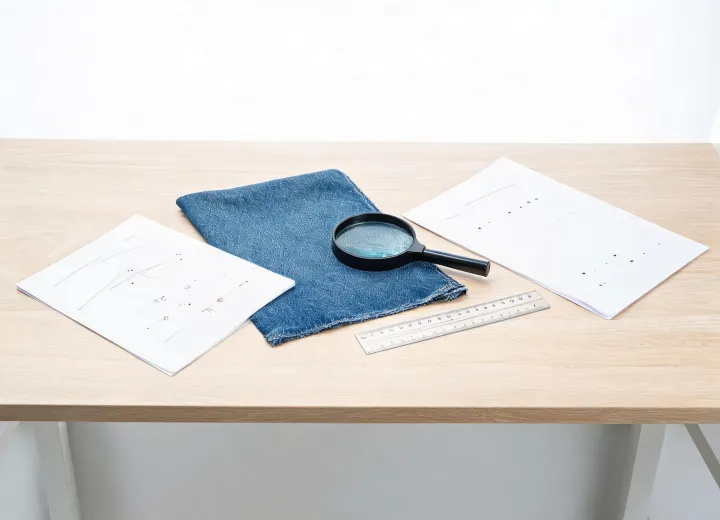
Four review lenses
Capture the exact article name or code, family, document title, publication or revision date, and source URL. A family label alone cannot establish composition, weight, width, stretch, or finishing.
Record fiber content, yarn and weave information when published, ounce weight or GSM, usable width, stretch direction, finish state, and whether values describe greige, finished, or washed fabric.
Define garment type, target silhouette, pattern demands, wash development, seam construction, care cycle, market, and the property that creates acceptance risk.
Retain the named method, specimen conditioning, unit, result status, article scope, color or finish qualification, and any statement that final validation belongs to the finished garment.
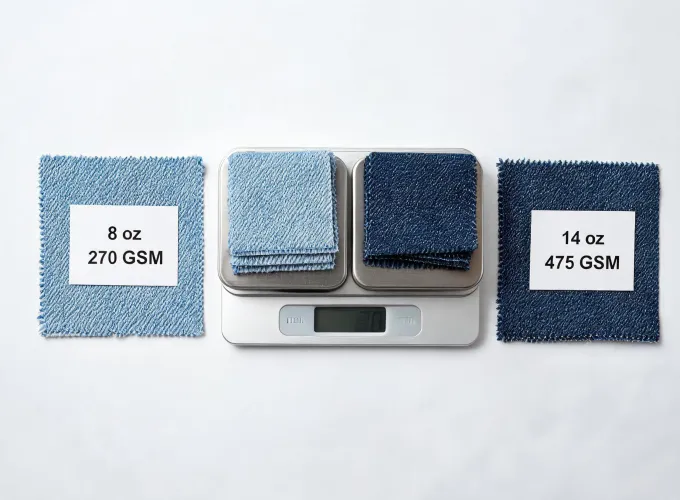
Review case: same family, different article
A stretch or performance direction may contain multiple constructions. One article can differ from another in fiber blend, weight, width, extension, recovery, dye route, finish, and intended application. A useful comparison therefore lists each current article on its own row and preserves the source for every value.
If a value is missing, mark it unknown rather than copying a nearby specification. If the source uses “typical,” retain that qualifier. If performance is measured after a stated wash or conditioning route, keep the route attached to the result. The outcome is a gap list for official confirmation, not a fabricated technical data sheet.
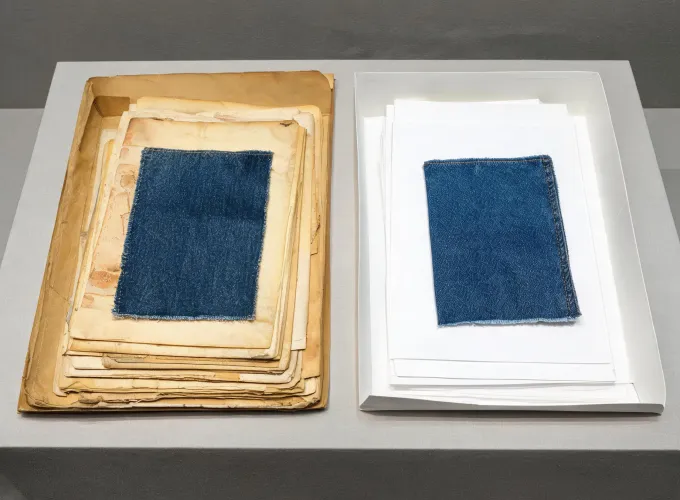
Review case: history versus supply
White Oak and Cone Mills have strong historical relevance to denim culture and product development, but a historical reference does not prove that a current article is made at White Oak, produced in the United States, available today, or technically identical to a vintage fabric. The site labels historical context as history.
For current work, use the exact article and current official evidence. Avoid turning an old mill name, archival cloth number, resale listing, finished Levi's garment, or collector description into a present production statement. Where origin matters, request the applicable current statement from the official brand and verify its scope for the specific article and order.
Independent context form
Use this form to organize an evidence question. This site does not provide quotations, samples, certification letters, mill confirmations, minimum quantities, lead times, inventory, or production capacity. Those requests must go to Cone Denim through an official channel.